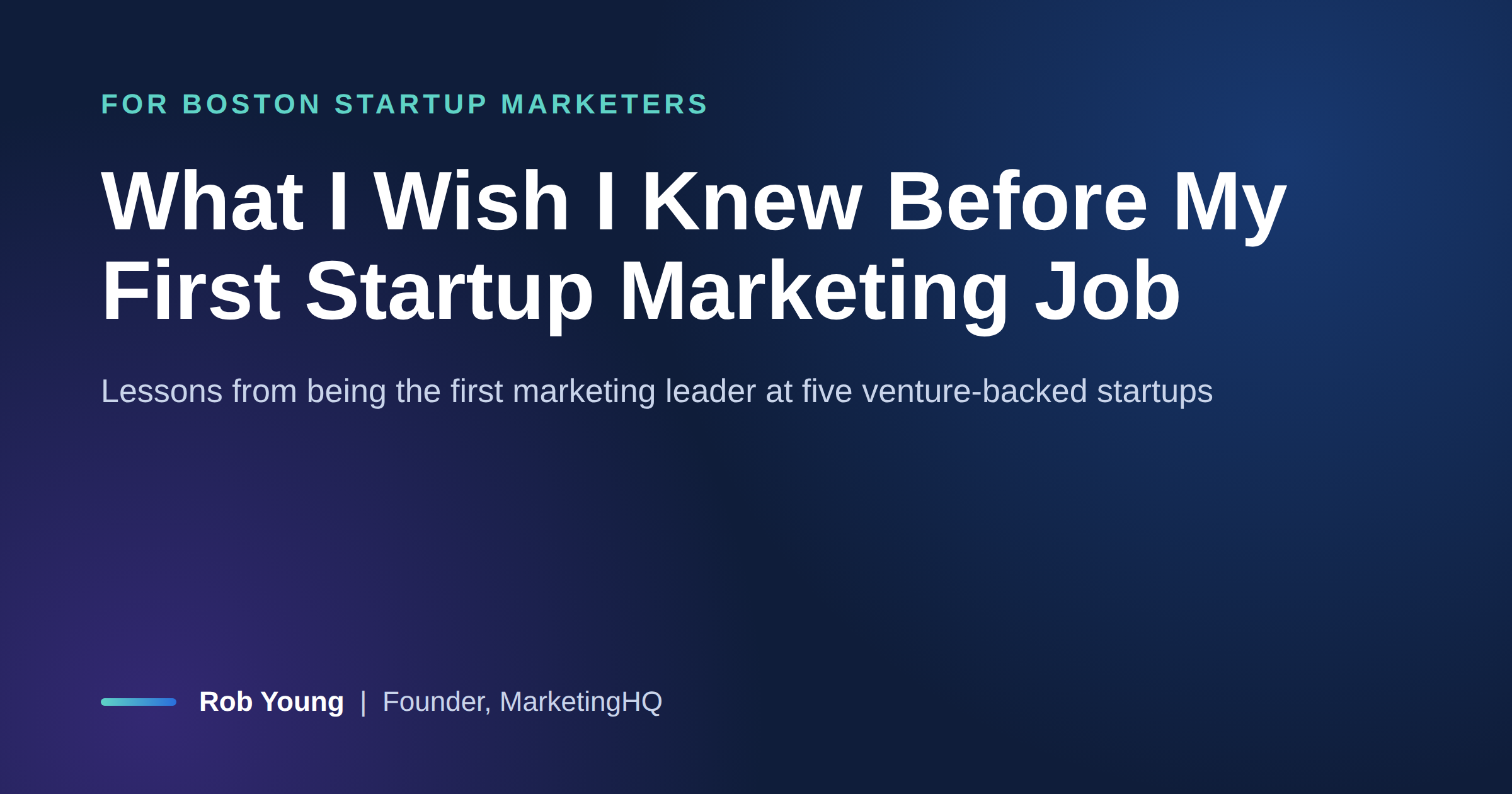
I’ve been the first marketing leader at five venture-backed startups. Seed through Series B, usually reporting straight to a first-time founder-CEO, usually with more ambition than budget, and a number that was already set before I walked in the door.
Every one of them taught me something I wish I’d known going in. Boston has no shortage of early-stage companies hiring their first marketer right now, so if you’re about to take that seat, here’s what I’d tell you over coffee.
The number was probably set before you got there, and nobody built it from real math.
Founders will tell you, “We want to get to $X million this year.” Wanting isn’t a strategy. That target usually came out of a board deck or a fundraise, worked backward from the outcome someone wanted instead of the inputs the company actually has.
Early on, I bought into all of it. It’s easy to get caught up in the excitement of a planning session, and I didn’t want to take the wind out of the leadership team’s sails or come across as confrontational. So I signed up for the plan.
Then it wasn’t working, and what had been a team conversation turned into a marketing problem. My problem.
So I spent years figuring out why it kept happening. Partly to defend myself against the blame, honestly. But mostly so we could stop losing and start winning. What I found, over and over, was that those exciting planning conversations were nine times out of ten built on fantasy. There was no real math behind them.
So I started slowing the room down. Before you own a number, rebuild it from your real conversion rates, current pipeline, ACV, win rate and sales cycle, and make the assumptions visible to everyone. The planning can still be fun and exciting. There’s just a lot less hangover at the end of the party when the fantasy doesn’t come true.
Capture demand before you try to create it.
If you’re in an established category, let the big incumbents spend their money educating the market. Early on you can’t afford to teach thousands of buyers why a problem exists, and you don’t need to.
Go after the demand that’s already out there: people searching competitor terms, showing intent, evaluating the category. Give them a reason to look at you. Prove marketing can turn existing demand into pipeline first. That’s what earns you the budget to create demand of your own later.
Positioning is a leadership decision, not a marketing task.
If you wait for the founder or product team to hand you clear positioning, you could be waiting a long time. Marketing may need to drive the work, but positioning shapes the whole company: who you target, what sales says, how product describes what it built.
Get the leadership team in the room early and agree on it together. Build it in a marketing silo and shop it around afterward, and you’ll spend the next month defending it one stakeholder at a time.
“Marketing isn’t working” usually means something upstream is broken.
You’ll hear it from the founder, the sales leader, maybe the board. Don’t get defensive, and don’t run off to generate more leads. Ask what exactly isn’t working. Awareness? Pipeline? Conversion? Win rate?
More often than not it traces back to a handoff nobody owns, or a definition of “qualified” that sales and marketing never agreed on. And unless your win rate is already healthy, more leads just make the problem bigger and more expensive. Diagnose before you sprint.
Your first budget’s job isn’t reach. It’s proof.
Don’t spread a small budget across six channels to “see what works.” You’ll learn very little from six underfunded experiments. Pick one or two, fund them well enough to get a real signal, and prove you can turn a dollar into pipeline.
Then give them time. Paid social needs weeks to build frequency before it produces anything. Kill it after three weeks and all you’ve learned is that three weeks wasn’t enough. Agree up front on how long you’ll run it and which early signals you’ll watch.
The founder doesn’t want campaigns. They want to know the number is safe.
They’ll ask for campaigns anyway. Launches, content, events, more activity. What actually keeps a founder up at night is whether revenue is going to show up. Part of your job is helping them see the difference, keeping the team focused, and giving the work you’ve already launched time to pay off.
Activity is easy to measure and it feels good. Outcomes pay the bills. Tie the work to pipeline and the number, and you’ll earn the trust that gets you resources and air cover when things get bumpy.
You’ll become the service desk unless you decide not to.
Every team at a startup will send you requests. A deck here, a one-pager there, a last-minute event. Say yes to everything and you’ll be busy, well liked, and strategically sidelined. You’ll also be the one blamed when the target is missed.
Saying no isn’t just a workload problem. It’s an authority problem. You have to earn the standing to protect your team’s focus, then actually use it.
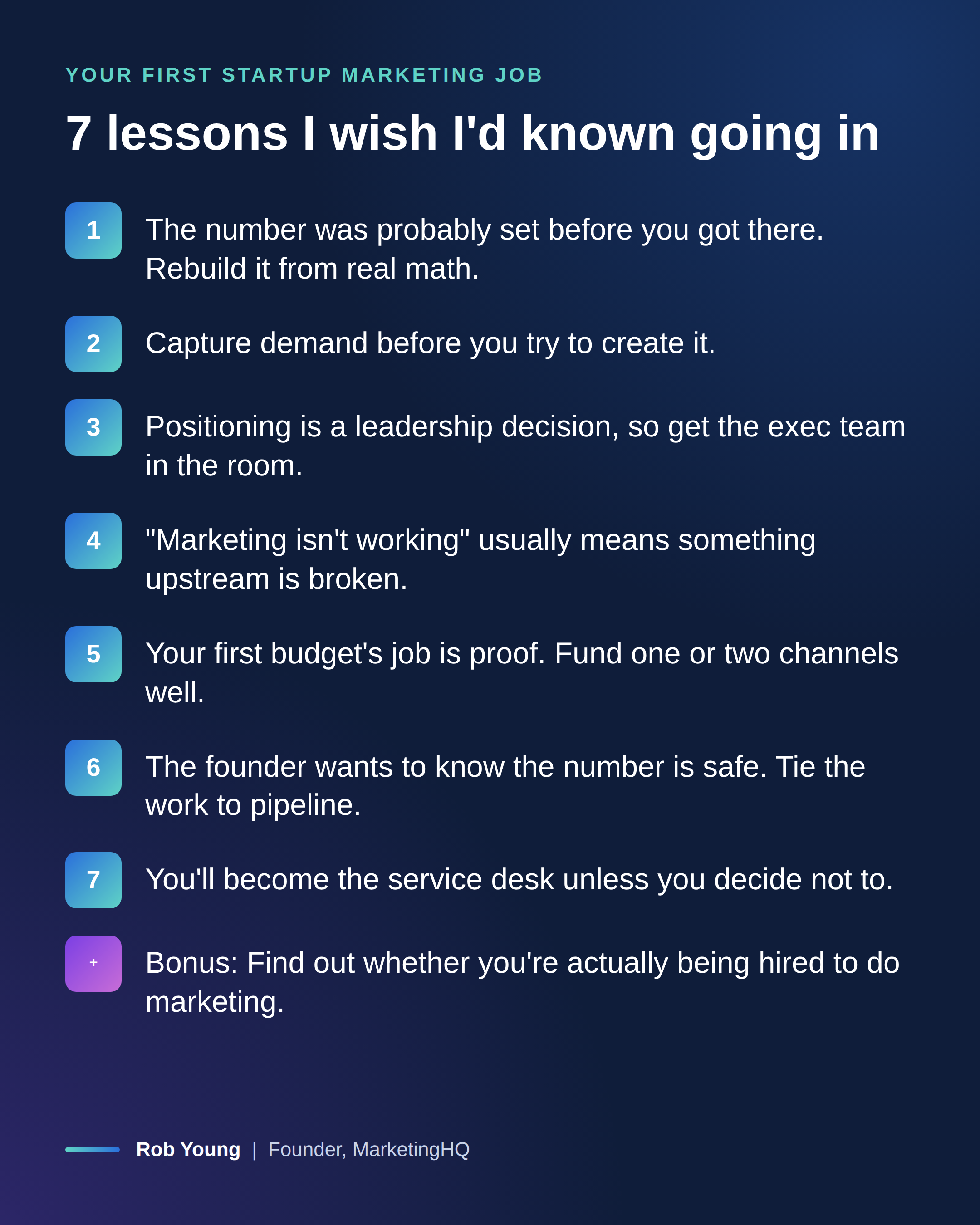
Bonus: Find out whether you’re actually being hired to do marketing.
I’ve joined companies with product-market fit and companies without it. On the org chart the jobs looked identical. In practice they had almost nothing in common.
With fit, your job is to capture and scale demand for something the market already wants. Without it, your job is to help figure out whether enough of the market wants it at all. Both can be great jobs. The trouble starts when you take the second one and everyone thinks they hired you for the first.
Don’t just take the founder’s word on PMF. Look at retention and churn, referrals, inbound, and whether the same kinds of customers are buying for roughly the same reasons. If every dollar of pipeline has to be manufactured by hand, ask why. Better to find that out in the interview than in your first board meeting.
The bottom line
Almost all of these come back to one thing. At an early-stage company the job isn’t simply running campaigns. It’s figuring out what has to be true for the company to hit its number, then owning the work that makes it happen, especially the handoffs between teams.
The title says marketing. The work is a lot closer to building the go-to-market system while it’s still being invented around you. It took me a few startups to figure that out. I hope it takes you just one.